
The 3D Web Interoperability Working Group of the Metaverse Standards Forum is proud to announce the release of the Web of Worlds (WoW) whitepaper. This document outlines a practical, open framework for an interoperable metaverse built directly on the proven principles of the modern Web.
Re-imagining the Metaverse as a “Web of Worlds”
While the current metaverse landscape is often fragmented into isolated “walled gardens” or closed platforms, the WoW vision reimagines it as a cohesive network of linked, addressable 3D worlds. Much like today’s websites form a unified digital ecosystem, these spatial experiences function as web endpoints that enable seamless navigation and traversal between virtual environments.
By providing a single URI for every discrete virtual world, users can move through the metaverse with the same ease they browse the 2D web. This approach leverages the power of linked spatial experiences, where complete or partial worlds can be referenced, bookmarked, and shared across platforms.
Built on Open Web Platform (OWP) Values
The WoW framework extends the core values of the Open Web Platform—universality, interoperability, decentralization, and accessibility—into 3D immersive environments. Our goal is to ensure the metaverse remains:
- Universal: Accessible through any standard browser on any device (desktop, mobile, or XR) without requiring proprietary software installs.
- Decentralized: Free from a single point of control or platform lock-in, prioritizing user-owned data and self-sovereign identity.
- Interoperable: Built on a foundation of open, royalty-free standards developed by consensus.
A Robust Technical Stack and API Architecture
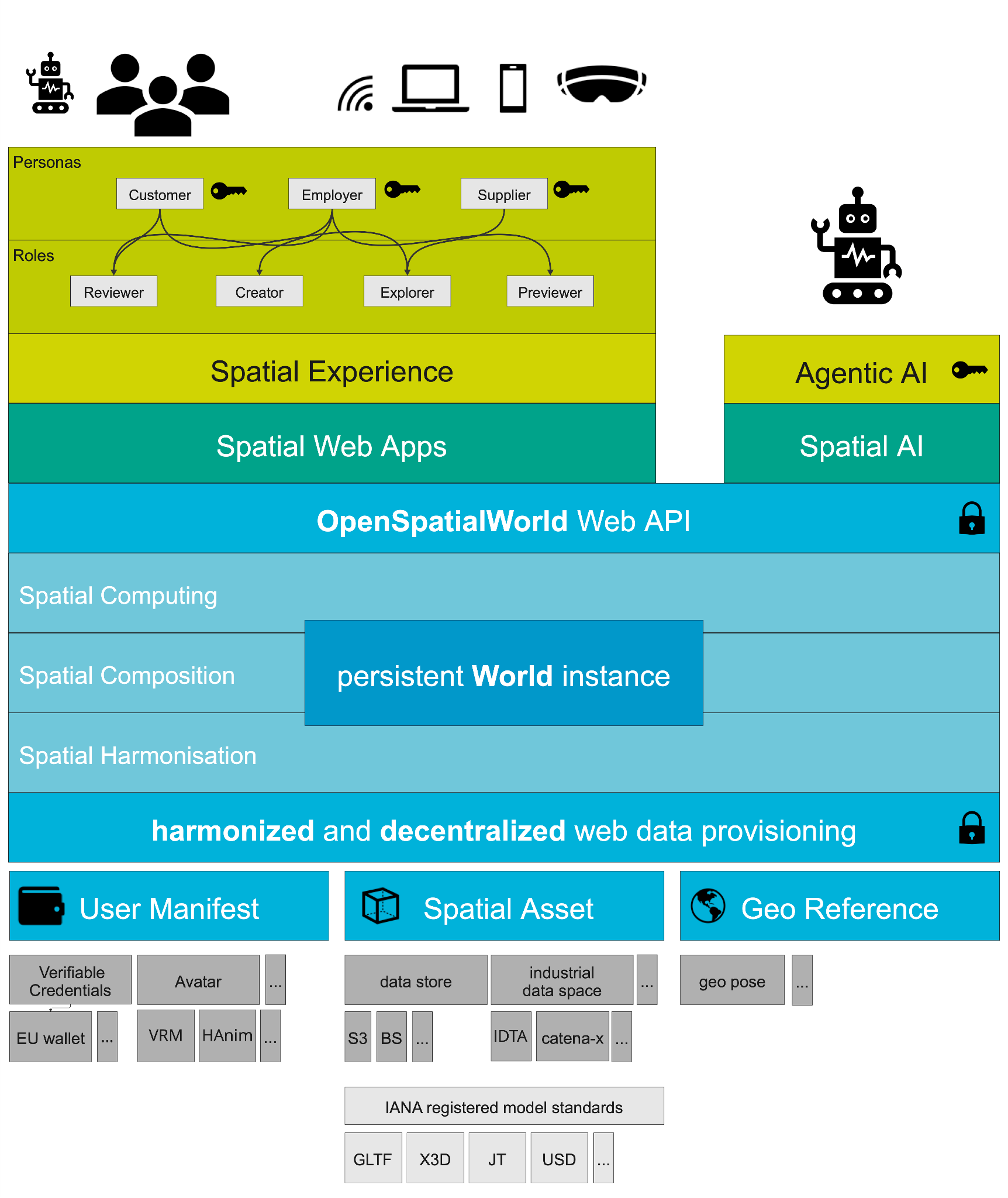
To reduce complexity and encourage adoption, WoW leverages a harmonized “glue layer” of existing standards. The architecture is built on three core pillars:
- Open Spatial World API: Treats virtual worlds as persistent API and HTTP endpoints, allowing users to join, view, and preview worlds using a single URI.
- Open User Manifest API (The “Digital YOU”): Powers a portable, user-controlled identity layer. Utilizing JSON-LD, Decentralized Identifiers (DIDs), and Verifiable Credentials, users can carry their avatars, preferences, and assets across different virtual worlds.
- Open Spatial Asset API: Facilitates modular, reusable 3D components by leveraging existing standards like glTF, X3D, and USD, which are already registered with IANA.
Privacy and User Ownership
Central to the WoW architecture is a “privacy-by-default” approach. By using a DID-enabled digital wallet to manage the User Manifest, individuals maintain full control over their data. The framework supports selective disclosure, ensuring only the data strictly required for a specific experience is shared, often with explicit consent prompts for the user.
Human-AI Collaboration
The WoW framework is designed for the future of human-AI symmetry. In this ecosystem, AI agents operate alongside humans as collaborative partners, following the same standards and API methods. These agents can perform “spatial computing” functions—such as computing bounding volumes or detecting collisions—to assist humans in complex virtual tasks.
Scalable Use Cases for Every Industry
The WoW vision provides a concrete roadmap for diverse applications, including:
- Industrial Digital Twins: Standardized 3D data exchange for engineering and manufacturing, aligning with initiatives like Catena-X.
- Education: Immersive 3D Web Field Trips that allow educators to transport students to virtual locations for remote learning.
- Collaboration & Social: Seamless virtual meetings and cross-platform social experiences where avatars and assets remain consistent.
- Gaming: Interoperable entertainment experiences with portable assets and “metaverse bookmarks”.
The release of this whitepaper marks a significant step toward an open and interconnected 3D Web. We look forward to working with MSF members and SDOs to develop the standards and the requirements illustrated in this document and specified in the WoW API.
Whitepaper summary and link to full pdf: https://webofworlds.github.io/initial_MSF_Whitepaper
Repo: https://github.com/WebOfWorlds/WoWAPI
New Home Page with own domain
webofworlds.org
Next steps
- Q2 implementation previews (per whitepaper): simpleWorlds, threedy.io
- Strategic alignments: OMBI workshop at SIGGRAPH LA; OpenARCloud and OMA3 ongoing via Spatial Computing WG, MSF
Web of Worlds is on track to become the second MSF Initiative after OMBI, creating two complementary initiatives advancing an open, decentralized metaverse. Target launch: SIGGRAPH.