
The Outernet Foundation’s open-source VPS is being added to Sneeze, the OMBI engine bringing spatial capabilities to the web.
Walk onto a factory floor wearing smart glasses. A maintenance alert appears above the exact valve that needs attention, and it stays there as you move around the machine. Nearby, a robot plans its route between workstations. Both the glasses and the robot depend on the same thing: each knowing precisely where it is.
That capability is called visual positioning, and today it is one of the most siloed parts of spatial computing. The Open Metaverse Browser Initiative (OMBI), hosted at the Metaverse Standards Forum, is working to break down those silos through Sneeze, the open-source browser engine bringing spatial capabilities to the web. The first standards-based VPS integration is now underway.
Positioning today is typically closed and proprietary
Most visual positioning systems (VPS) work the same way. A device sends camera images to a cloud service run by a single vendor, which works out the location and sends it back. The software is closed source, the maps live on the vendor’s servers, and the person or organization using the device has no say over where their camera images go, how long they are kept, or how they are used.
For many enterprises, that is a dealbreaker. Hospitals, airports, and manufacturers often cannot stream camera feeds from their facilities to servers they don’t own. And when a vendor shuts its service down, as several already have, everything built on it stops working.
Also, each system exposes its own proprietary positioning API, with no cross-vendor portability. An application built against one provider cannot move to another without being ported, so developers cannot easily select a VPS depending on their use case and location.
An open-source alternative that cannot disappear
Placeframe, from The Outernet Foundation, takes the opposite approach. It is free and open source under a permissive Apache 2.0 license, so any company can use it and no one company can withdraw it. Using Placeframe, organizations can scan their facilities to build their own spatial map and host it themselves, keeping full ownership of the maps, scans, and positioning data they create. That is exactly what a private facility such as a factory or hospital needs. Maps can also be georeferenced, so content can be anchored by GPS coordinates. Devices can then send images to the enterprise server to determine their position. On-device positioning, so camera data never even has to leave the device, is next on the Placeframe roadmap.
The Outernet Foundation is a 501(c)(3) nonprofit, and built Placeframe to be a vendor-neutral foundation for augmented reality, the way Linux became a shared foundation for servers and Apache for the web.
“We built Placeframe because we believe the infrastructure layer of augmented reality should belong to communities, not platforms. Every major VPS before this has been proprietary and cloud-dependent, and several have already been shut down, leaving developers and organizations stranded,” said Tyler Hatch, founder and chairman of The Outernet Foundation. “Connecting to Sneeze means Placeframe will be able to serve as a positioning layer for the open spatial computing ecosystem. That is exactly the kind of future we set out to build.”
Standard APIs so every component is interchangeable
Sneeze does for spatial browsing what Blink and WebKit do for web browsing. It can run inside an existing web browser, power a standalone metaverse browser, or be built directly into a device.
Sneeze is being designed so that every key capability (such as visual positioning, multi-origin scene composition, proximity-based content discovery, real-time co-presence, and certificate-based security) sits behind an open, interoperable API. Any VPS provider can implement that API to plug into Sneeze, and organizations can choose a provider and switch later without rebuilding. The choice can also change as the user moves: a browser can use a city-scale provider while someone is navigating outdoors, then seamlessly switch to a self-hosted VPS such as Placeframe when they step into their own premises, all through the same interface and with no change to the application.
The VPS interface is being defined now. It will return positions using GeoPose, the Open Geospatial Consortium standard for expressing the position and orientation of any real or virtual object, so content positioned by any provider can be shared and composed in a common frame.
“Computing is moving off flat screens and into physical space, into factories, hospitals, airports, and the infrastructure that runs the global economy. All of it needs accurate spatial positioning, and none of it should be solely dependent on any single vendor’s proprietary system,” said Neil Trevett, president of the Metaverse Standards Forum and the Khronos Group. “By defining a standardized interface through which any provider can supply location data to Sneeze, we are applying the principle that made the web work: open infrastructure that belongs to no single company, with multiple implementations competing to serve it.”
Placeframe: helping to define the standard VPS interface
Placeframe is now being integrated with Sneeze, and The Outernet Foundation is working with OMBI to shape the VPS interface. Placeframe will be the first VPS, and the first open-source VPS, to connect to Sneeze through that interface, to be showcased in Rubidium, the reference metaverse browser being built by RP1. OMBI is publicly sharing the work while it is in progress, so developers, device makers, and positioning providers can follow along and provide feedback and requirements. A demo of Placeframe operating in Sneeze is expected before the end of 2026.
“We are not locking the browser to use any one positioning system. Any VPS provider can connect to Sneeze through the same API. Placeframe is first because The Outernet Foundation shares our commitment to open source and data ownership, but the architecture is open to everyone,” said Sean Mann, co-founder and CEO of RP1, which architects and maintains Sneeze. “When enterprises deploy spatial computing in factories or hospitals, they need the option to own their maps, own their scans, and own their positioning data.”
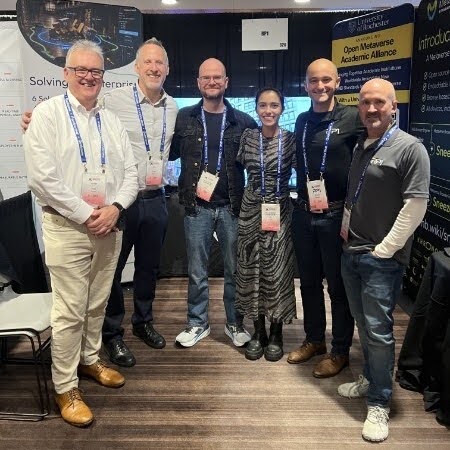
The OMBI and Outernet Teams at Augmented Enterprise Summit, Atlanta October 2026
Get involved
This is an open invitation to positioning providers, device makers, developers, and enterprises planning spatial deployments to help build the future of the metaverse. You don’t need to be a Metaverse Standards Forum member to contribute to the OMBI open-source projects, but organizations that want a voice in the broader metaverse interoperability standards discussion are encouraged and welcome to join the Forum.
- Learn more about Sneeze: omb.wiki
- Learn more about Placeframe: outernetfoundation.org
- Placeframe on GitHub: github.com/outernet-foundation/placeframe
- Learn more about OMBI: metaverse-standards.org/open-metaverse-browser-initiative
- Contact the Metaverse Standards Forum to get involved: metaverse-standards.org
About the Metaverse Standards Forum
The Metaverse Standards Forum is a nonprofit consortium dedicated to fostering metaverse interoperability. It is open to any organization, including standards bodies, companies, and universities, and brings members together to coordinate requirements, prototyping, plugfests, and open-source tooling for an open, inclusive, and accessible metaverse. The Forum hosts the Open Metaverse Browser Initiative.
About The Outernet Foundation
The Outernet Foundation is a 501(c)(3) nonprofit based in New York that builds free and open-source infrastructure for augmented reality. Its flagship project, Placeframe, provides visual positioning and localization infrastructure that communities and organizations control on their own terms. outernetfoundation.org